Showing posts with label homeschooling. Show all posts
Monday, September 12, 2016
School is Cool?
It has been almost a month since we decided to put M and S in public school. Shortly after they started their classes, I started mine: I am on campus five days a week this semester and I have field work to do. I knew it was going to be a difficult schedule and an uncomfortable transition, but assumed we just needed some time to adjust. Now, I'm not sure.
Laundry isn't getting done or folded. The playroom is rarely getting cleaned. Every time papa mentions some as yet unscheduled activity, I want to shoot it down because I immediately assume anything new is going to be the thing that makes my google calendar explode. On top of that stress, I'm having very mixed feelings about this public school business.
M is in first grade. She's doing fine. She's a little behind with her reading, but we knew that. I think sending her to school has renewed her motivation to pick up sight words and work through short books. Something about having her teacher backing us up, and sending home packets of stuff to work on has made her more serious. She's got someone new to impress, I guess.
Her teacher, a young man so tall and muscular that he would be intimidating if he weren't so darn friendly, is optimistic. He also uses a program called "class dojo" to keep in contact with parents, which I really appreciate. I have had to use the app to ask him for advice on getting the dry erase markers out of her clothes, and he is able to inform me if she is having a moody day.
S, on the other hand, is in fourth grade. She is struggling with more than just the academic part of public school. Her teacher says she's struggling with math and handwriting. The handwriting doesn't surprise me, but she's doing the math homework just fine, with almost no help... and choking on the quizzes in class. She made friends, but her friends are the target of playground bullying. She shares her classroom table with two boys who argue with each other constantly and have no interest in her, and a girl who doesn't speak much English. She doesn't want to go. She mopes every weekday morning, and her teacher describes her (on the phone with me) as "sad".
I have talked to S's teacher only once. I have never seen her. I knew about the playground bullying several days before I was able to tell her teacher... who apparently didn't know. I could have guessed that S was sad in class, but I didn't know until the end of last week, when she finally called.
S says she feels like her teacher cares about her. So, now that she knows about the playground situation, and I know about the all-day sadness, it's time to see if things improve. The teacher wants to try moving S to a different table and says the school takes bullying "very seriously". But I'm skeptical about bullying policies. I'm not sure that any amount of "seriously" is going to fix the problem. Still, we intend to give this a few more weeks to work itself out before we deploy the parachute... and we're not quite sure what that is going to be just yet.
Monday, August 15, 2016
A Tough Decision
Today, I'm going to the local elementary school to finish the paperwork that will allow two of my daughters to attend school. This has been an incredibly difficult decision. I'm not sure if it's the right decision, so I won't bother trying to defend it. But let me explain it.
I've been pretty overwhelmed lately. C still has persistent potty problems, and my multi-tasking is not strong enough to give her enough attention while also trying to teach S math, and M reading, and chase a three-year-old who constantly wants me to play "ring the gack" with him (thanks, Dr. Seuss). In part it is my college education getting in the way. But, also, I'm hoping that a formal school environment will help encourage M to read and S to learn math because they are falling behind in those areas at home.
So, S and M are about to be off to public school. I cried about it. I've lost a lot of sleep. I've wanted to give up and just keep them home because of how frustrating the enrollment process has been... because, let's be honest, no one is excited to go through a long, difficult negotiation just to achieve something they're not even sure they want. It's nearly impossible to stay motivated.
Reminding myself why I started homeschooling seems to help.
When I was first faced with the decision of schooling, all of the girls were clearly struggling to cope with our shared past. We were getting settled in to a new life and I wasn't comfortable sending them straight off to school. They were fragile and, to varying degrees, broken. I lost my job and I was going through a nasty divorce, being verbally torn down as I tried to rebuild out daughters. But now they're vibrant, confident, and difficult... just as little ladies should be.
The other reason I kept them home was that C had potty problems. I didn't think it would be fair to send a girl who was still having frequent accidents to public school. Stigma aside, I needed her home so we could attend a variety of medical appointments and procedures, and so we could work together on the problem. And this is an on-going problem, which we seem to have to find new solutions for all the time. I think she needs more of my time and attention and less of her siblings' distractions.
I didn't follow this path because I thought I could do a better job, or because I thought it was my calling, or anything like that. I chose this life for what I still believe to be good reasons. And, for those same reasons, I think it's time to make a change.
We will certainly still supplement their education at home. And we're already looking at wait-listing them at better schools. I just think it's time to start letting go.
Friday, July 15, 2016
I Want to Talk About Privilege
Privilege is defined as a right or advantage gained by birth, social position, effort, or concession. We call it a privilege when we let our kids pick what we have for dinner because they did well on their homework or when an older sibling is allowed to explore the neighborhood alone while a younger sibling is not.
Privilege isn't always fair. Sometimes the sixteen-year-old gets to drive the car even though she is far less responsible than her thirteen-year-old sister, because driving is a privilege given to sixteen-year-olds with a certain amount of disregard for practicality, under the guise that "it's normal".
For that reason, and other reasons, privilege doesn't always make people happy. My three-year-old is pretty chafed about not being allowed in our back yard by himself. In his case, he just doesn't understand why the unequal distribution of privilege is reasonable. He keeps harassing the chickens, heedlessly wandering out the gate, and otherwise making questionable decisions when no one is looking. But what if I took privileges away from my children because another child lied about something my child did? What if I took privileges away because of a presupposition about children in general without ever giving my children a chance to prove themselves?
Actually, I think all parents are guilty of that last one. We have to be. We put babies in cribs because, although our child hasn't yet become mobile, we know that children generally do. We keep putting our toddler down for a nap because we're pretty sure kids need naps, even if we haven't tested that theory on this particular toddler. We limit screen time because studies show that less is best, even though "studies show" just means "generally, for most kids".
This is important. we apply privilege to our kids based on generalized ideas because it is much easier than testing every theory individually on each child. In fact, I don't think we could do that if we tried. Generalizations are important for allocation of privilege in parenting.
Problems arise when we start using those generalizations to judge the way other parents choose to allocate privilege for their children. As long as what they're doing isn't illegal, I think we need to consider that maybe the parent knows best. For example: My niece gets more screen time than my kids. None of my kids have ever shown a particular inclination to learn from electronic devices or shows. My niece, on the other hand, is three years old and trying to teach herself to spell and read with an app on a tablet.
So far, you're with me because this doesn't make you uncomfortable.
So let's talk about racial privilege. Remember, a privilege is a right or advantage gained by birth, social position, effort, or concession. Up to now, we've been talking about privileges bestowed upon our children by concession (on our part) or effort (on theirs). Racial privilege is decided at birth.
If you needed to shop for an educational children's book, would you have trouble finding one with a central character who shares your ethnicity? "Once Upon A Potty", probably the most popular potty training book aimed at toddlers, is available in two variations: White boy and white girl.
If you had neighbors of a different race and there was a dispute, how concerned would you be that they might just call authorities? My kids used to play with our neighbor's young relatives every time they would visit. Then, we had an incident that involved a young boy kissing one of our daughters and we told his parents. Now, the neighbors hardly talk to us. We are white and our neighbors are black. I worry that we unknowingly and unintentionally threatened them.
Do you ever worry that if you make a choice that goes against the grain or results in a mistake, it will be chalked up to your ethnicity? I have this problem with gender privilege. I am frequently concerned that if I appear soft, disorganized, too mean, too nice, or too caring it will be brushed off as part of my femininity and not attributed to me as a person.
With recent events... shootings and revolts... I think this is an incredibly important topic, even if it makes a lot of people uncomfortable. Privilege doesn't affect all people of a given race equally, and not all people are guilty of perpetuating it. But the fact remains, it is easier to grow up white in America because there is always a place for you. There is always a doll that looks like you, a hair product that works for you, a book that relates to you, a teacher who gets you. And it's easier to be a white adult in America because people don't make nearly as many negative assumptions about you. If you want to go to that "ethnic hair products" place because you like their dye selection, you might feel a little out of place, but they will still help you find what you're looking for without tailing you to make sure you don't steal anything. This is what people mean when they talk about white privilege.
Some people are uncomfortable talking about this with their children. Some would say we should avoid talking about it with our children because we don't want to pass this social problem down to the next generation. I say that's all the more reason to tell them.
We teach our children about all kinds of things we never want to happen to or around them. We tell them about the dangers of drugs and alcohol and the consequences of irresponsible sex and other behaviors. If we didn't tell them about these boogeymen, they wouldn't just go away. The same is true with racial privilege. I'm going to tell my kids about privilege so I can arm them against contributing to, or even simply ignoring the problem. I hope they see a time when racial privilege doesn't exist, but if that never happens, I hope they are at least aware that they have it, so they can use it to fight the good fight.
Privilege isn't always fair. Sometimes the sixteen-year-old gets to drive the car even though she is far less responsible than her thirteen-year-old sister, because driving is a privilege given to sixteen-year-olds with a certain amount of disregard for practicality, under the guise that "it's normal".
For that reason, and other reasons, privilege doesn't always make people happy. My three-year-old is pretty chafed about not being allowed in our back yard by himself. In his case, he just doesn't understand why the unequal distribution of privilege is reasonable. He keeps harassing the chickens, heedlessly wandering out the gate, and otherwise making questionable decisions when no one is looking. But what if I took privileges away from my children because another child lied about something my child did? What if I took privileges away because of a presupposition about children in general without ever giving my children a chance to prove themselves?
Actually, I think all parents are guilty of that last one. We have to be. We put babies in cribs because, although our child hasn't yet become mobile, we know that children generally do. We keep putting our toddler down for a nap because we're pretty sure kids need naps, even if we haven't tested that theory on this particular toddler. We limit screen time because studies show that less is best, even though "studies show" just means "generally, for most kids".
This is important. we apply privilege to our kids based on generalized ideas because it is much easier than testing every theory individually on each child. In fact, I don't think we could do that if we tried. Generalizations are important for allocation of privilege in parenting.
Problems arise when we start using those generalizations to judge the way other parents choose to allocate privilege for their children. As long as what they're doing isn't illegal, I think we need to consider that maybe the parent knows best. For example: My niece gets more screen time than my kids. None of my kids have ever shown a particular inclination to learn from electronic devices or shows. My niece, on the other hand, is three years old and trying to teach herself to spell and read with an app on a tablet.
So far, you're with me because this doesn't make you uncomfortable.
So let's talk about racial privilege. Remember, a privilege is a right or advantage gained by birth, social position, effort, or concession. Up to now, we've been talking about privileges bestowed upon our children by concession (on our part) or effort (on theirs). Racial privilege is decided at birth.
If you needed to shop for an educational children's book, would you have trouble finding one with a central character who shares your ethnicity? "Once Upon A Potty", probably the most popular potty training book aimed at toddlers, is available in two variations: White boy and white girl.If you had neighbors of a different race and there was a dispute, how concerned would you be that they might just call authorities? My kids used to play with our neighbor's young relatives every time they would visit. Then, we had an incident that involved a young boy kissing one of our daughters and we told his parents. Now, the neighbors hardly talk to us. We are white and our neighbors are black. I worry that we unknowingly and unintentionally threatened them.
Do you ever worry that if you make a choice that goes against the grain or results in a mistake, it will be chalked up to your ethnicity? I have this problem with gender privilege. I am frequently concerned that if I appear soft, disorganized, too mean, too nice, or too caring it will be brushed off as part of my femininity and not attributed to me as a person.
With recent events... shootings and revolts... I think this is an incredibly important topic, even if it makes a lot of people uncomfortable. Privilege doesn't affect all people of a given race equally, and not all people are guilty of perpetuating it. But the fact remains, it is easier to grow up white in America because there is always a place for you. There is always a doll that looks like you, a hair product that works for you, a book that relates to you, a teacher who gets you. And it's easier to be a white adult in America because people don't make nearly as many negative assumptions about you. If you want to go to that "ethnic hair products" place because you like their dye selection, you might feel a little out of place, but they will still help you find what you're looking for without tailing you to make sure you don't steal anything. This is what people mean when they talk about white privilege.
Some people are uncomfortable talking about this with their children. Some would say we should avoid talking about it with our children because we don't want to pass this social problem down to the next generation. I say that's all the more reason to tell them.
We teach our children about all kinds of things we never want to happen to or around them. We tell them about the dangers of drugs and alcohol and the consequences of irresponsible sex and other behaviors. If we didn't tell them about these boogeymen, they wouldn't just go away. The same is true with racial privilege. I'm going to tell my kids about privilege so I can arm them against contributing to, or even simply ignoring the problem. I hope they see a time when racial privilege doesn't exist, but if that never happens, I hope they are at least aware that they have it, so they can use it to fight the good fight.
Tuesday, June 28, 2016
Can I Still Do This?
My birthday was yesterday, and a birthday seems like a good time to really consider what you're doing with your life. I'm two years into school. I've got 52 credits and a GPA of 3.47, but I'm looking at having to slow down because Cub is demanding a lot of my attention and classes are getting harder. The classes are getting objectively more difficult, but doing almost anything has gotten more difficult for me. Writing blogs, for instance, has become almost impossible.
I decided to dial back the intensity of my college grind because I felt like I was making unacceptable sacrifices. Although our homeschool has always been very free-range, which makes for a lot of useful flexibility, last semester still stretched my time thin. My Women in World History class demanded a lot of attention and Botany required substantial time spent studying, which made me feel like I wasn't able to encourage the kids to learn as much as I normally would.
To put it simply: I got a B in my botany class, and I would give myself a C in homeschooling last semester. I made sacrifices in both areas just so we could all get through the term. We all passed. We all learned. Despite my copious pile of distractions, the kids still all worked on reading, math, art, social skills, biology, and computer skills. Still, I know we would have made more progress if I had more time to spare.
I know we could have done better because, now that I'm home for the summer, we are doing better. Cub finally decided he wanted to learn his ABCs (so he can learn to read, so he can play Munchkin), so I taught him. The twins have been working on irregular spelling words, parts of speech, place value and multi-digit math. M has been focused on consonant blends and improving her reading skills.
I still think homeschooling is the only right answer for us right now. C still has potty problems, which I don't feel like any doctor has given us a good explanation for. S still has a little bit of a tongue thrust speech irregularity. But the biggest factor is that we can't afford the types of schools we would consider sending them to regardless of those issues, and even if we could, we'd have to move.
I don't always love homeschooling. My kids don't always love it either. One of my friends (also a mom and one of my professors) pointed out that, "Kids act completely different to other adults than their parents." I think that is my biggest struggle. Additionally, they all want to take separate classes because they have a really hard time focusing when they're around their siblings. It's the dinner-table dilemma. Four siblings around the dinner table can not be talked into quieting down and eating. Four siblings working on homeschool work seem to take four times longer to finish one task.
What we are doing is difficult, but because I still feel like it is the best option, I will cut back my hours at school and try a little harder at home.
Wednesday, December 2, 2015
I Failed
Remember that math test I was pretty sure I failed? I did, in fact, fail. What's weird is, I felt better, not worse, when I saw my grade. In fact, I felt a lot better. I felt relieved. I don't exactly know why, but I think it's something like this:
I will still probably get a B. Like I said, I did really well on the previous two test and all of the homework and I'm not too worried about the final. I just need to study this weekend.
I failed a test and it was okay. It means I'm trying something new and difficult.
So, here's what I learned about parenting, and this is an important topic that a lot of people seem to be talking about lately: It's important to teach your kids that failing is... not only okay, but essential. If you are pushing yourself, trying something new, expanding your boundaries, you are going to fail sometimes. It's important to see that failure for what it is and learn from it. You don't have to feel bad about it. Feeling bad about it is a waste of your time and emotional energy. Besides, there's really nothing to feel bad about since everyone fails sometimes.
I think I expected disappointment. I expected to be disappointed in myself, but I also expected everyone I told to be disappointed. I don't want to disappoint people I care about, so I had an uncomfortable lump of fear. When no one reacted the way I expected, I thought, "Well, of course. I'm not in compulsory school anymore. My failure or success is entirely my own and no one has the power or reason to berated me for my shortfall anymore."
But why does anyone berate anyone for their shortfalls? Why do we breed fear of failure in our kids? They get pressure from every different direction. Their siblings judge them for being less capable in some way or another. Their teachers pressure them by giving them definitive grades and expecting them to learn at the set pace of the classroom (this reminds me of a blog about the pressure of grades I wrote over a year ago). Their peers label them for struggling with a concept. They don't need more pressure to perform... it just becomes more fuel for fear of failure.
I want my kids to fail, because I want them to be trying. I want them to be changing and growing and pushing the limits. I want your kids to do the same. The kids who don't fear failure will be the future innovators who stand on the edge and say, "we can make this jump". Maybe they fall, but they can get back up, armed with new information and try something else. They will be the leaders who change everything because they're not afraid to try.
Ask your kids what they failed at today... and be proud of them. Talk about what they learned and be glad that they tried. Make it a friendly, comfortable topic. Destroy the fear.
- I hadn't failed a test in my adult life previous to this, so now I've set a record... and a bar. It's okay to make mistakes. It's okay to fail. It happens sometimes. I know I've been pretty busy and had a lot of crazy stuff going on in my life lately, so I don't take this one too personally. And, so far, I've only failed this test, which came at a bad time for me and included a lot of difficult stuff and, it turns out, everyone else did surprisingly poorly as well. Which brings me to the next point.
- It was an anomaly. I got A's on my other two tests in that class. I've gotten perfect or near perfect grades on the homework. It wasn't a surprise, because I went into the test knowing that I wasn't really prepared. Still, it was an exception, not part of a trend.
- No one was upset with me. Some people expressed some sympathy (or empathy, since anyone who has ever tried to get a college degree has probably failed a test), but no one was disappointed. That includes my professor. She recognized that this was unusual for me and the rest of the class and is offering us an opportunity to get some extra credit by reworking the problems we missed and turning the test back in on the day of the final.
I will still probably get a B. Like I said, I did really well on the previous two test and all of the homework and I'm not too worried about the final. I just need to study this weekend.
I failed a test and it was okay. It means I'm trying something new and difficult.
So, here's what I learned about parenting, and this is an important topic that a lot of people seem to be talking about lately: It's important to teach your kids that failing is... not only okay, but essential. If you are pushing yourself, trying something new, expanding your boundaries, you are going to fail sometimes. It's important to see that failure for what it is and learn from it. You don't have to feel bad about it. Feeling bad about it is a waste of your time and emotional energy. Besides, there's really nothing to feel bad about since everyone fails sometimes.
I think I expected disappointment. I expected to be disappointed in myself, but I also expected everyone I told to be disappointed. I don't want to disappoint people I care about, so I had an uncomfortable lump of fear. When no one reacted the way I expected, I thought, "Well, of course. I'm not in compulsory school anymore. My failure or success is entirely my own and no one has the power or reason to berated me for my shortfall anymore."
But why does anyone berate anyone for their shortfalls? Why do we breed fear of failure in our kids? They get pressure from every different direction. Their siblings judge them for being less capable in some way or another. Their teachers pressure them by giving them definitive grades and expecting them to learn at the set pace of the classroom (this reminds me of a blog about the pressure of grades I wrote over a year ago). Their peers label them for struggling with a concept. They don't need more pressure to perform... it just becomes more fuel for fear of failure.
I want my kids to fail, because I want them to be trying. I want them to be changing and growing and pushing the limits. I want your kids to do the same. The kids who don't fear failure will be the future innovators who stand on the edge and say, "we can make this jump". Maybe they fall, but they can get back up, armed with new information and try something else. They will be the leaders who change everything because they're not afraid to try.
Ask your kids what they failed at today... and be proud of them. Talk about what they learned and be glad that they tried. Make it a friendly, comfortable topic. Destroy the fear.
Labels:
college,
fail,
homeschool,
homeschooling,
life,
parent,
test
Wednesday, October 21, 2015
A Difficult Six
We celebrated M's birthday the weekend before she actually turned six. Her birthday was on a Wednesday, and Papa and I are both gone all day on Wednesdays. We both leave the house at 7am. I drive to school and he goes to work. Then, we don't get home until after 5pm. Normally, birthdays that fall on weekdays get moved to the weekend after, that way we don't miss any cards or gifts that our far away relatives might have mailed. This year, though we had plans for the weekend after M's birthday: zombie crawl. Besides, we were having family visit for the weekend before her birthday. We like to share birthdays with family.
We don't make a big social event out of birthday parties. We don't send out invites or plan to have tons of guests. We have four kids - three birthdays - all in the fall/winter. We don't have that kind of budget. On a couple of occasions, though, birthdays have fallen near times when people were planning to visit for other reasons. So, we throw the party in while our guests are here.
Sometimes I ask what theme they want for the party. For M, I already knew. She checked out a book about sharks from the library and renewed it the maximum number of times, keeping it for 9 weeks. We read it multiple times. She learned (and actually retained) a lot of weird facts about sharks. Did you know that the outer layer of shark skin is made of tiny, tooth-like things called dermal denticles? Skin teeth. Seems like sharks are basically made of teeth. She was sad to see the book go.
So, M had a shark party.
I spend days making cakes and other baked goods for birthdays. I think I'm hoping that my kids will remember that when they're older. My mom says they'll remember that and think, "no way. I'm not baking cakes." That's okay. I just want them to remember how much I cared about their birthdays. Plus, I love baking.
Decorating is rewarding but stressful. Fondant is... torture that sometimes produces desirable results. But baking is relaxing. With three birthdays every year for the last 8.5 years, I've found some great cake and frosting recipes. I get better at decorating every time I try it, but... it's a slow process.
This year, I made cookies with royal icing t
o go with M's cake. I had never made or used royal icing before. The recipe I used didn't turn out quite as smooth as I would have liked. The cookies took an entire day to make and decorate from start to finish. They tasted okay. They were honestly kind of unremarkable, but they were worth making because now I can try again and do things a little differently until I get it right. You have to start somewhere.
We went to the fall festival before coming home for cake and cookies. She played in a giant hamster ball and a bounce house and ate festival food. I didn't take a lot of pictures of that. She had a great time and everyone was a bit sad when we had to go home. There were so many other things they wanted to do at the festival, but we didn't have time.
This year, Daddy got to be at her party. For a few years, he lived more than a thousand miles away, in Florida. Now, he lives five minutes away, in an apartment complex with a pool. They see him several times a week, now. They get to have dinner with him twice every week. He gets to be at their birthday parties.
M's six years old, now. She's really into sounding out new words and slowly adding new sight words to her vocabulary. She loves library books. She loves sharks and wants to learn to rock climb and go indoor skydiving. She likes to sit on the roof of the playhouse and talk to the kid on the other side of the back fence.
She's going through a bit of a regressive phase recently. Daddy has told me that "regressive phase" is a nice way of saying it. For the last couple of months, she refuses to do what we ask her to do. She pouts, whines and throws fits in "baby talk". She briefly decided that if we asked her to go somewhere, she would, instead, grab on to the nearest large object and refuse to move. She looks frustratingly pleased with herself (or maybe with our reactions) as she does these things.
So, predictably, she gets timeouts. We have always had timeouts for fit-throwing and disobeying. We make an effort to distinguish between requests and commands, and commands are mandatory. If she refuses to respond to a command, we warn her of the possibility of a timeout. If she continues to refuse, she gets a timeout. Her timeouts are now 6 minutes long.
Consistency seems to be helping. It sure helps me retain my sanity, just knowing what comes next. I'm sure she just wants more attention. There's a lot going on around here. She has the twins as older sisters, and they have each other. She has the Cub as a baby brother, and he gets a lot of adult attention because he's potty training and always in things he shouldn't be. I'm at school twice a week, Papa is at work five days a week, Daddy is at school and busy most of the time. I imagine she feels pretty alone.
I'm going to try to work on that.
We don't make a big social event out of birthday parties. We don't send out invites or plan to have tons of guests. We have four kids - three birthdays - all in the fall/winter. We don't have that kind of budget. On a couple of occasions, though, birthdays have fallen near times when people were planning to visit for other reasons. So, we throw the party in while our guests are here.
Sometimes I ask what theme they want for the party. For M, I already knew. She checked out a book about sharks from the library and renewed it the maximum number of times, keeping it for 9 weeks. We read it multiple times. She learned (and actually retained) a lot of weird facts about sharks. Did you know that the outer layer of shark skin is made of tiny, tooth-like things called dermal denticles? Skin teeth. Seems like sharks are basically made of teeth. She was sad to see the book go.So, M had a shark party.
I spend days making cakes and other baked goods for birthdays. I think I'm hoping that my kids will remember that when they're older. My mom says they'll remember that and think, "no way. I'm not baking cakes." That's okay. I just want them to remember how much I cared about their birthdays. Plus, I love baking.
Decorating is rewarding but stressful. Fondant is... torture that sometimes produces desirable results. But baking is relaxing. With three birthdays every year for the last 8.5 years, I've found some great cake and frosting recipes. I get better at decorating every time I try it, but... it's a slow process.
This year, I made cookies with royal icing to go with M's cake. I had never made or used royal icing before. The recipe I used didn't turn out quite as smooth as I would have liked. The cookies took an entire day to make and decorate from start to finish. They tasted okay. They were honestly kind of unremarkable, but they were worth making because now I can try again and do things a little differently until I get it right. You have to start somewhere.
We went to the fall festival before coming home for cake and cookies. She played in a giant hamster ball and a bounce house and ate festival food. I didn't take a lot of pictures of that. She had a great time and everyone was a bit sad when we had to go home. There were so many other things they wanted to do at the festival, but we didn't have time.
This year, Daddy got to be at her party. For a few years, he lived more than a thousand miles away, in Florida. Now, he lives five minutes away, in an apartment complex with a pool. They see him several times a week, now. They get to have dinner with him twice every week. He gets to be at their birthday parties.
M's six years old, now. She's really into sounding out new words and slowly adding new sight words to her vocabulary. She loves library books. She loves sharks and wants to learn to rock climb and go indoor skydiving. She likes to sit on the roof of the playhouse and talk to the kid on the other side of the back fence.She's going through a bit of a regressive phase recently. Daddy has told me that "regressive phase" is a nice way of saying it. For the last couple of months, she refuses to do what we ask her to do. She pouts, whines and throws fits in "baby talk". She briefly decided that if we asked her to go somewhere, she would, instead, grab on to the nearest large object and refuse to move. She looks frustratingly pleased with herself (or maybe with our reactions) as she does these things.
So, predictably, she gets timeouts. We have always had timeouts for fit-throwing and disobeying. We make an effort to distinguish between requests and commands, and commands are mandatory. If she refuses to respond to a command, we warn her of the possibility of a timeout. If she continues to refuse, she gets a timeout. Her timeouts are now 6 minutes long.
Consistency seems to be helping. It sure helps me retain my sanity, just knowing what comes next. I'm sure she just wants more attention. There's a lot going on around here. She has the twins as older sisters, and they have each other. She has the Cub as a baby brother, and he gets a lot of adult attention because he's potty training and always in things he shouldn't be. I'm at school twice a week, Papa is at work five days a week, Daddy is at school and busy most of the time. I imagine she feels pretty alone.
I'm going to try to work on that.
Monday, October 19, 2015
We Did the Volcano Thing
One of our awesome, amazing, lovely family members got us a subscription to something really cool thing that I didn't even know existed. If you're homeschooling, you might love this, too. It's the Magic School Bus, Young Scientist Club.
We've been receiving their bubble-packed envelopes for most of a year, and I can now tell you that they are definitely worth it. If I were a little better at planning, I could organize our school schedule to focus on the topics in that month's Magic School Bus kit. They email in advance to let you know what the topic will be and what you will need in order to perform the experiments. Unfortunately, as I have detailed before, my life is a bit of a mess lately... sometimes it feels like an endless train wreck that I can do nothing to avoid, and just have to clean up after when the dust finally settles. So, there are envelopes we haven't opened and experiments we haven't done.
Some of the "experiments" aren't really... experimental. In one of our first envelopes, we got (among many other things) a card-stock print of a leg, cut in half at the knee, a couple of bits of string and a brass brad. We attached the two leg segments with the brad and taped the ends of the pieces of string so that one end attached to the lower half and one to the upper. I gather this was supposed to replicate the muscles moving the parts of the leg. As a biologist-in-training, I felt the need to explain that this was very simplified and... not really how this works. Still, it was a great conversation starter that resulted in education points that don't generally come up on their own.
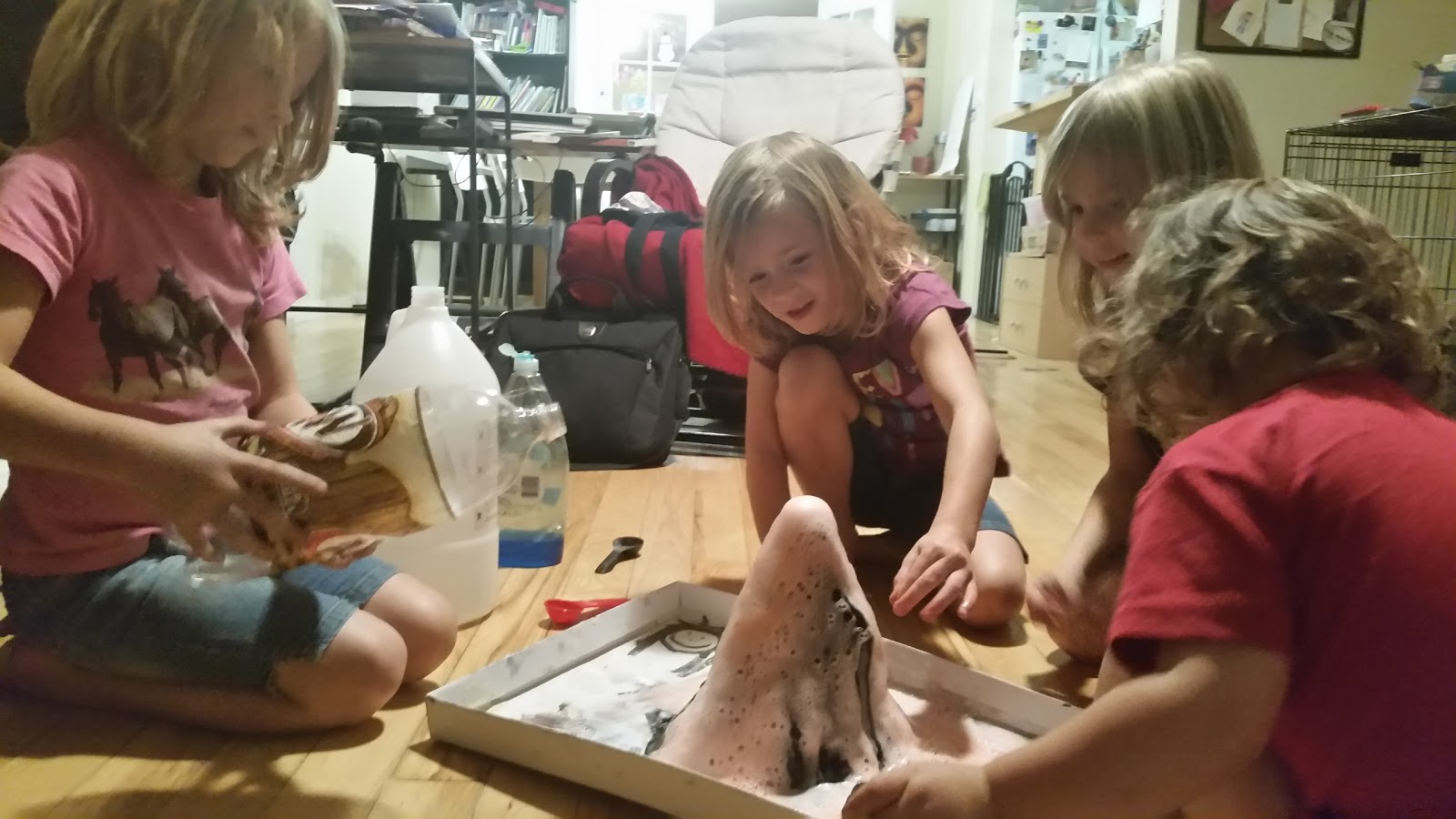
My favorite so far was the most stereotypical science fair experiment ever: making and erupting a volcano. (obviously, there's a reason people love this one)The instructions for the volcano experiment come in different phases. First, you build the structure with a small soda bottle and paper mache. The instructions are specific about what size of bottle, so you don't end up with a bottle too big for your solution to explode from. The kit doesn't include the bottle, but does come with tough construction paper to build your cone-shape and some powdered black paint. A lot of what you need comes from your kitchen: Flour, water and a bowl to make your paper mache, and vinegar, baking soda, red food coloring, soap and measuring cups/spoons for the "lava".
After you've built the volcano, your kids will slowly become more and more impatient before (maybe) just giving up all together, while you wait for it to dry completely before using it. It takes... days. You build it and you wait a long time... then you paint it and you wait another long time. Or at least that's how ours went. It's possible that my kids were overzealous with the mache and paint. They were incredibly excited about the project.

But before you explode your volcano, you've got some work (read: learning) to do. I bet you thought you were just going to follow some directions with specific quantities and get the perfect, explosive solution. Not so fast. The Magic School Bus directions don't make it that simple. Instead, they tell you what to put in, but not how much, and give you a few different blank spaces to write out what you used each time so you can come up with the ideal solution on your own. (we used a camelback bottle for our preliminaries so the kids could see what was happening inside)I think that was the best part. We talked about how baking soda and vinegar react with one another and explained that you could use that knowledge to figure out if you needed more baking soda or more vinegar. Take the puddle of already reacted mess and add a little baking soda to one area. Does it react a lot? Now add vinegar to another area. Does that react more or less?
We came up with our perfect solution and put it in our volcano. It was amazing, and even the Cub loved it. And with all of those mixture tests we did on the front room floor, the hardwood is super sanitary now.
Tuesday, October 13, 2015
First Time Tenting
It's mid-term season. Time to panic and study a lot. Apparently, it's also a good time for everyone to get sick. I missed an important day of training at the zoo because I had some kind of 24 hour stomach bug. I also missed an important day of standing in the passport line at the post office because I chose, instead, to spend that day waiting at an urgent care clinic so I could get an antibiotic prescription.
I managed to make up the passport day, but I'm still not sure when I'll get to make up the zoo training. Oh well. It could have been worse. At least I was lucky enough to have Papa stay home so I could rest. He even called in for me. Sweet guy.
Now, I want to take a moment to revisit some of the good times.
About a month ago, before all of this mid-term/sick business started, we all went camping with some friends. We had been trying to figure out how to go since the Cub started sleeping through the night, but kept talking ourselves out of it. How do you take a little guy camping with you? Was he going to sleep in a pack-n-play? What if he wouldn't sleep? What would we feed him? How are we all going to fit in our tent with a pack-n-play anyway?
Now, he's been sleeping in a toddler bed for months and eating what we eat for well over a year, but we didn't like the odds: 2 adults vs 4 small children, so we continued our holding pattern. Then, we realized that we have some amazing friends who also love camping and being outdoors. Who'd have guessed that we'd be friends with people like us?
They picked the camp site, helped us out with some gear and brought camp food. In fact, they handled a lot of the logistics, and I don't think we could have done it without them. Their preparedness allowed us to spend our time watching the kids and enjoying the experience. It was the first time the kids had been camping at all, and the first time I had been camping since I was a kid.
There's a learning curve. Just like playing video games, using new lab equipment, tap dancing and baking, it's probably best to take your kids camping for the first time with people who have a lot of recent experience with kids and camping (if not combined, then separately). I'm thankful we had some help. Besides, these people are good company.
We had a lot of fun. The kids explored the wilderness with practically every moment they could. They also got a lot of entertainment out of a glow stick and some red flash lights once the sun went down. We built a fire, roasted marshmallows and made s'mores. We all had/got to pee in the woods.
That, by the way, is a unique adventure. I think every kid should get to do it. The Cub is potty trained, and will stand to pee in the grass, but he relied on his potty the whole time we were out. Papa and I had to find places to dump/bury the contents. The girls, however, all took care of business like the grown ups... with only one, unfortunate incident.
We slept like sardines in our "6 person" tent. The Cub only complained that he wanted his bed for several minutes before passing out and sleeping the whole night through in his mummy bag. The girls all claim that sharing a tent with him was the worst part of the weekend, but I can't really imagine how.
It was cold and frosty when we woke up. It was definitely nearing the end of the campable season for leisure campers like us. The mummy bags we borrowed from our friends were lifesavers in the cold night, but the morning view was beautiful. Probably my favorite part of camping is waking up with the sun and enjoying the scenic sunrise. I always feel more awake after camping than I do at home.We played and explored for the day, headed back down the mountain a bit for lunch, and then went home. The kids were all a little disappointed to be going home. I'm sure they're excited to go camping again, but we won't be able to sleep in that tent again until the warm weather comes back.
Monday, August 10, 2015
What?
Conflict Resolution. I think these might be buzz words for our entire adult lives. I haven't been an adult for that long, but it doesn't seem like conflict resolution is ever going to stop being a topic of conversation.
Major political decisions are made with conflict resolution in mind. Thus, the way an individual deals with conflict can decide his or her political leanings. Conflict resolution can decide who your friends are and aren't, what activities you participate in, how far you're able to push for personal success, and how happy your entire life is. In my mind, I can't imagine a more significant and consistently useful tool, and it is learned in early childhood. In fact, watch out, because your kids will learn it accidentally (and maybe incorrectly) if you aren't teaching it to them deliberately.
I put the tent up in the back yard for my kids to play. I've done this a few times before, and it's generally fine. For some reason, today, the twins kept running into disagreements. For example: C wanted the windows open so she could see the butterflies in the garden. S wanted them closed, so C pushed S away from the windows. S came stomping toward the house declaring that she hates the tent.
This was a perfect opportunity to first point out that she doesn't hate the tent, she's just angry, then turn her back around and insist that she talk to her sister about what just happened. "Stomping off doesn't solve anything." But it's like pulling teeth, trying to get eight-year-old sister to talk about their disagreements. I feel like this is an incarnation of snake charming. I have to perform some special song in just the right way to get their words to come out... one... sentence... at a time.
The conversation went something like this:
Me: Tell your sister what happened.
C: She knows what happened.
Me: That's not the point. You still need to tell her.
C: She was closing the window.
Me: Tell her, not me.
C: You were closing the window.
Me: Now, why was that a problem?
C: Because she knew I was trying to catch butterflies.
Me: Tell her, not me.
You can probably imagine how the rest of it went.
Then, half an hour later, we had another kerfuffle. After prying that whole previous conversation out of both of them, I immediately felt the heavy burden of parenting being thrust upon me with the offended whine as the screen door closed behind C.
I guess S did a cartwheel in the tent, so she kicked C in the stomach because there's not really enough space for that. Instead of telling her what happened, C stormed off. I'd have liked to have thrown my hands in the air, tilted my face toward the ceiling, and exclaimed (to no one in particular), "No one listens to me!" I thought those things. But I said this: "Did you tell her what happened?"
Of course, C replied, "She knows what happened."
At this point, S came in and I set up the conversation so that I was pretending to be C, so C could see why it is important to tell what happened, even if you think the other person knows.
Me: You did a cartwheel in the tent, right?
S: Yeah.
Me: You did a cartwheel in the tent and you kicked me in the stomach.
S: Oh.
Me: Did you know that?
S: I do now.
Me: You did a cartwheel in the tent, so you kicked me in the stomach. Now, I think we shouldn't do cartwheels in the tent anymore.
S: Okay.
Sure, I reiterated the facts more times that I probably needed to, but the basis for the conflict resolution method I'm trying to teach them is this: What? So What? Now What?
What started this? You did a cartwheel in the tent.
So what happened? So, you kicked me in the stomach.
Now what should we do? Now, I think we shouldn't do cartwheels in the tent anymore.
I explained those steps to them and that I know it's hard to have these conversations. However, I think this method is very helpful because you can make a very convincing argument, and usually come to a mutually agreed-upon solution.
What? So what? Now what? is a useful angle for dealing with a number of things. Here is a Forbes article that explains how to use this method to turn data into appropriate actions. These questions also make great tools for reflecting on your work. What did you do? So, what did you learn or accomplish? Now, what direction should you go from here? There are lots of ways to consider these three questions, it would be impractical to try to list them all, but I think if you use the questions and a guide for untangling messy conflict, you'll find that they help, and they're so easy to remember. I hope to help my kids memorize them so they have a safety net for dealing with difficult situations.
Friday, August 7, 2015
Don't Let Me Get Me
I bought some of those Brain Quest work books, on sale, at the grocery store the other day. I made some copies of pages from the Language Arts section of the second grade book. Wednesday, we sat down with them and had a review session. We talked about parts of speech I know we had talked about before, but probably forgotten. We practiced writing and how to form a statement vs a question. We reviewed punctuation and capitalization (which, I'm not gonna lie, I've told them all about a dozen times before, but still watch them flagrantly disregard).
The biggest obstacle we are having in our late summer refresher so far is this: ourselves.
C blasted right through the worksheets without much trouble, and only a few reminders. (ex: Tiny A is not a lower case a.) But S, who was doing just as well as C, was crying like writing sentences was painful. She could identify the common nouns, proper nouns, and pronouns. She could tell me how to order the words in the word bank to form a statement or a question. She could tell me which pronoun works best in each scenario. She was just writing like her pencil was the blood quill Umbridge uses on Harry Potter (okay. It wasn't that bad.)
It is my job to be patient and non-judgmental. I have not always been good at this, but I know I've gotten better. I repeatedly encouraged her with observations like, "Look, that's a really good spacing between your words. You've already improved." and, "Yes! That is how you make a lower case A, and you figured it out on your own!" I deliberately didn't correct every mistake, thinking I would choose our battles sparingly and we would have plenty of opportunities to cover everything else some other time. Spare her some stress. Still, the process seemed to be killing her.
So, we went through the worksheets, skipping the writing, to see if she got the concepts. Then, I gave her a sheet of paper with the standard, capital and lower-case, alphabet on it and this sentence: "The five boxing wizards jump quickly."
That sentence lightened the mood. How silly. Wizards?! It's just a random pangram I picked in order to give her practice writing sentences while she also writes all of her letters (especially the lower-case ones, because she's pretty much got the capitals down). After I got an accidental laugh out of her, and stopped asking her to do what she perceived as real work, as opposed to just informal practicing, things calmed down a lot. The worksheets were too serious. No matter how I tried to remind her that this was just between me and her and it was just good practice, she was kicking herself for making mistakes.
I told her it reminded me of that P!nk song from 2001, Don't Let Me Get Me. "Don't let me get me. I'm my own worst enemy. It's bad when you annoy yourself. So irritating. Don't wanna be my friend no more. I wanna be somebody else."
Copying a sentence about wizards cheered her up and she was still able to show me that she has all the skills we were trying to review today. Unfortunately, this exercise reminded me of why public school scares me a bit. Would her teacher have had the time or understanding to defuse this situation and find a way for S to get around it? Maybe. Maybe not.
The biggest obstacle we are having in our late summer refresher so far is this: ourselves.
C blasted right through the worksheets without much trouble, and only a few reminders. (ex: Tiny A is not a lower case a.) But S, who was doing just as well as C, was crying like writing sentences was painful. She could identify the common nouns, proper nouns, and pronouns. She could tell me how to order the words in the word bank to form a statement or a question. She could tell me which pronoun works best in each scenario. She was just writing like her pencil was the blood quill Umbridge uses on Harry Potter (okay. It wasn't that bad.)
It is my job to be patient and non-judgmental. I have not always been good at this, but I know I've gotten better. I repeatedly encouraged her with observations like, "Look, that's a really good spacing between your words. You've already improved." and, "Yes! That is how you make a lower case A, and you figured it out on your own!" I deliberately didn't correct every mistake, thinking I would choose our battles sparingly and we would have plenty of opportunities to cover everything else some other time. Spare her some stress. Still, the process seemed to be killing her.
So, we went through the worksheets, skipping the writing, to see if she got the concepts. Then, I gave her a sheet of paper with the standard, capital and lower-case, alphabet on it and this sentence: "The five boxing wizards jump quickly."
That sentence lightened the mood. How silly. Wizards?! It's just a random pangram I picked in order to give her practice writing sentences while she also writes all of her letters (especially the lower-case ones, because she's pretty much got the capitals down). After I got an accidental laugh out of her, and stopped asking her to do what she perceived as real work, as opposed to just informal practicing, things calmed down a lot. The worksheets were too serious. No matter how I tried to remind her that this was just between me and her and it was just good practice, she was kicking herself for making mistakes.
I told her it reminded me of that P!nk song from 2001, Don't Let Me Get Me. "Don't let me get me. I'm my own worst enemy. It's bad when you annoy yourself. So irritating. Don't wanna be my friend no more. I wanna be somebody else."
Copying a sentence about wizards cheered her up and she was still able to show me that she has all the skills we were trying to review today. Unfortunately, this exercise reminded me of why public school scares me a bit. Would her teacher have had the time or understanding to defuse this situation and find a way for S to get around it? Maybe. Maybe not.
Wednesday, August 5, 2015
They Want To Try Public School
How does anyone who has kids full-time ever blog?! All you other home-school bloggers are obviously wizards.
The twins want to try public school. I rode my bike (because I guess I'm that kind of person) to the administrative office, where there was no bike rack (because I guess there aren't that many of us). I went in expecting to talk to someone about options for my girls because they've been home-schooled for their entire education so far, and one of them has special, medical considerations. Instead, I found a room that reminded me of the social security office. You come in with your enrollment paperwork and turn it in at the desk, where they review it and your proof documents and send you on your way.
When I tried to ask who I should talk to about my concerns, they suggested I just enroll my kids and then talk to someone. What? "I don't want to enroll them. I want to talk to someone about our situation and our options first." I was directed to another woman who gave me two phone numbers. One, which was supposed to be the direct line to the special education coordinator, turned out to be the home number of someone with an entirely different name. The other, the office number, did get me through to the coordinator, who said she isn't the person I need to talk to.
She said I need to talk to my local school about a 504 plan, after asking if we already had a 504 plan. I had never heard of a 504 plan, because I home-school my kids and we've never needed a legal document that "spells out the modifications and accommodations that will be needed" (special children) for my kids to be able to perform at the same level as their peers. I am their teacher, their nurse, their principal. My multiple personalities don't need to sit down and agree on terms.
So, I called my local school. I told them our situation. I explained what I had heard so far. At this point, I still didn't know what a 504 was, I just used the term in this context: "the special education lady said I need a 504." Again, I was asked if we already have a 504. Again, I reiterated that we are home-schooling, and, though I don't even know what a 504 is, it sounds like a public school paperwork thing... so... no. And, again, I heard that I need to just enroll my kids and then talk to someone about their needs. I said, "I think that seems a little excessive. I'm not prepared to enroll them without knowing what we're getting ourselves into." So, I was forwarded to the 504 coordinator. So, I got to introduce myself as a "concerned parent" yet again, and explain our home-schooling/medical needs situation... again.
Finally, someone told me what a friggin' 504 is... but only after she asked if we already have one. I finally just said, "I don't even know what it is. Like I said, we home-school, so we don't have any public school paperwork except what says we don't go to public school. I just heard I needed one." At this point, I'm thinking the more I have to deal with these people the less I trust them to educate my kids.
The 504 coordinator said we could set up a time for me to come in and talk to the nurse about what our 504 would look like. We could figure out, in advance, what would be in our plan, but we couldn't write it up until after the girls are enrolled. This makes a lot more sense to me. You can't write up a legal agreement for a kid who isn't even associated with the school yet.
However... it'll be a few days before I even hear back from the 504 coordinator to try to schedule a time because they share the nurse with three other schools and they don't know exactly when they'll see her again in order to find out when she's available. She doesn't have a phone? An email address? What if she's at another school and you have a kid with a broken limb or something? I understand the pressures that result in sharing a nurse among several, nearby schools... but if you're going that route, how are you not able to contact her when she's not in her office?
The more I think about it, the less I like this public school business.
Saturday, January 3, 2015
3.85, 5, 2, and 2015 (catching up)
My littlest little is faithfully using his potty (as long as he's not inhibited by clothes). My two oldest have started earning money by doing chores. My middle child is learning to read. Tonight, the littlest cub, my two-year-old, is super excited about the water in the toilet tank. He's grabbing our fingers and dragging us each, in turn, to the bathroom to show us. At the same time, the rest of the children in the house are excitedly playing with key chain animals that squeal in various ways. I got those things as stocking stuffers. I knew better, but didn't listen to my internal monologue. It's been a busy life, lately.
A semester came and went. My grades were pretty good. Sure, I got a B in lab, but I wasn't exactly impressed with my professor. To be fair, he had never taught Gen Bio at all, and it was his first go at this Gen Bio lab business. I really think he'll fair much better next semester, and the school has given him a chance to teach the class as well as the lab this time.
M's birthday happened. It kills me that she's five. She still hasn't learned to read. I taught her sisters at four, but M is considerably less interested. I guess she's got better things to do. She's also a lot more free-spirited and flighty than I remember her sisters being. I definitely don't want to kill her happiness, but I grit my teeth when she smiles at me while I'm trying to talk to her about her tantrums.
Anyhow, I'm teaching her to read this year. She's making great improvements in the way of remembering her letter-recognition and learning phonics already. We're also seeing some considerable strides in her writing. All of this centers around her rapidly improving attitude, which I'm thrilled to see.
Of course, there was Halloween. And, of course, we had an Elsa, though no adult I know can comprehend why children all seem to prefer Elsa. We also had a Yoda, a Bat Girl and a Victorian Princess. I loved M's costume so much. E said, "coo coo" at every house, to much adoration. At the time, it was his way of saying, "thank you". He has since upgraded to something like, "Tek oo".
Thanksgiving happened in a strange sort of way. We all took turns getting sick, which resulted in very last minute cancellation of our traditional road trip to St. Louis. (To those of you we missed seeing on that holiday, you dodged a bullet. Please remember we had you and your children's best interests in mind when we cancelled.) So, instead, we had our first Thanksgiving at home with my mom, sister and niece. It was actually quite nice. However, the kids and I haven't seen some of my in-laws since summer vacation, which is unfortunate.
Christmas came and went. There was a fake tree, because of time and budget restrictions, but there were something like five different kinds of homemade cookies, several flavors of glass candy (from my sister) and two different fruit pies I made from scratch. And that fake tree was adorably dwarfed by the pile of presents for the five children who woke up here Christmas morning.
New Years was lovely. We finally got to see a good friend we hadn't seen in six months. He wound up staying the night because, upon his opening the front door to leave at 2am, we were greeted with the disharmony of police sirens from who knows where and realized... driving home might not have been the best idea.
A semester came and went. My grades were pretty good. Sure, I got a B in lab, but I wasn't exactly impressed with my professor. To be fair, he had never taught Gen Bio at all, and it was his first go at this Gen Bio lab business. I really think he'll fair much better next semester, and the school has given him a chance to teach the class as well as the lab this time.
It wasn't easy, and I don't want to make it seem like it was. I skipped out on this blog mostly because I was so stressed out about my grades and having a lot of trouble finding time and privacy to do my homework. I figure if don't feel like you're under pressure, you're probably not learning anything new or challenging.
M's birthday happened. It kills me that she's five. She still hasn't learned to read. I taught her sisters at four, but M is considerably less interested. I guess she's got better things to do. She's also a lot more free-spirited and flighty than I remember her sisters being. I definitely don't want to kill her happiness, but I grit my teeth when she smiles at me while I'm trying to talk to her about her tantrums.
Anyhow, I'm teaching her to read this year. She's making great improvements in the way of remembering her letter-recognition and learning phonics already. We're also seeing some considerable strides in her writing. All of this centers around her rapidly improving attitude, which I'm thrilled to see.
Of course, there was Halloween. And, of course, we had an Elsa, though no adult I know can comprehend why children all seem to prefer Elsa. We also had a Yoda, a Bat Girl and a Victorian Princess. I loved M's costume so much. E said, "coo coo" at every house, to much adoration. At the time, it was his way of saying, "thank you". He has since upgraded to something like, "Tek oo".
Thanksgiving happened in a strange sort of way. We all took turns getting sick, which resulted in very last minute cancellation of our traditional road trip to St. Louis. (To those of you we missed seeing on that holiday, you dodged a bullet. Please remember we had you and your children's best interests in mind when we cancelled.) So, instead, we had our first Thanksgiving at home with my mom, sister and niece. It was actually quite nice. However, the kids and I haven't seen some of my in-laws since summer vacation, which is unfortunate.
Christmas came and went. There was a fake tree, because of time and budget restrictions, but there were something like five different kinds of homemade cookies, several flavors of glass candy (from my sister) and two different fruit pies I made from scratch. And that fake tree was adorably dwarfed by the pile of presents for the five children who woke up here Christmas morning.
Cub turned two (which is also freaking me out) but we haven't had his party yet. We were hoping to improve his birthday experience by 1.) distinguishing it from Christmas with at least one whole week of buffer and 2.) financially recovering from Christmas before trying to throw him a party. I want him to have a real party with a theme and all like everyone else gets, and his birthday falling on the 26th makes that awfully difficult.
He suddenly wants us to read him every book from the bookshelf, several times a day. He sleeps in a toddler bed, faces forward in his carseat, and mostly takes showers with us instead of baths. Cub loves all things that go: firetrucks, dump trucks, backhoes, helicopters, rockets, robots, airplanes, and trains. His current favorite things to talk about (and request youtube videos of) are rockets and astronauts. He even says "Atronot". He got a rocket for Christmas (A note to Tutu, who got it for him: he sleeps with the detachable lander portion) and has a small toy Ernie doll he like to put in the rocket. Now, he's pretty sure that Ernie is an astronaut and asks me if the NASA astronauts in the youtube videos are Ernie.
New Years was lovely. We finally got to see a good friend we hadn't seen in six months. He wound up staying the night because, upon his opening the front door to leave at 2am, we were greeted with the disharmony of police sirens from who knows where and realized... driving home might not have been the best idea.
We had our traditional milk in champagne glasses, cracked holiday crackers, wore paper crowns, popped poppers and let the twins try to stay up until the new year. They made it to 11:45. To pass the time, we played a bit of D&D, because that's how we roll.
I finished up the 2014 memory jar, but we haven't reviewed it just yet. I think I don't want to let it go.
**I really wanted to add about 20 more photos to this, but it was getting ridiculous.**
Thursday, September 4, 2014
Thoughts on Grades
I'm taking a sociology class this semester. This is really not my game. Rarely do I come across an article or book that isn't far too scholarly or heavy for me to enjoy. It kills me how these people write. For example:
I would like to suggest to you that the competition for grades, which you have already experienced for 12 years and will experience for at least four more, is a very dehumanizing and damaging system that has its roots deep in the injustices of our society. - Bell, Inge, Bernard McGrane, John Gunderson. This Book is Not Required: An Emotional Survival Manual for Students. Pine Forge Press, 2004. Print
When first I read that, I nearly laughed out loud. I thought, "That seems awfully dramatic. It's just a letter. These people really take this too seriously!" But... do they?
They go on to explain their point of view:
Throughout our school years, society teaches us to believe that grades display our intelligence. Because of this our motivation, learning, and personal growth are placed second to attaining the ultimate goal - the grade. Society first teachs us about societal norms and codes, yet it is in the school system where we are ultimately taught to imitate. We are programmed to imitate what the teacher wants. If we don't, we get a bad grade. This idea of imitation is so strong because it is reinforced through schooling for a minimum of 12 years. Imitation is the main cause for our stifled and structured society. Imitation, competition, and fear of grades hinder our discovery. - Bell, Inge, Bernard McGrane, John Gunderson. This Book is Not Required: An Emotional Survival Manual for Students. Pine Forge Press, 2004. PrintOkay. If grades are one leg of the tripod that is stifling our discovery and our entire society, maybe they aren't taking it too seriously. Still, I wasn't sure I could make the connection between letter grades and ruining society. Can you?
Do you remember getting gold stars for little achievements? I gave my kids skittles for using the potty. When I was in 3rd grade, we had a sticker chart that showed who had mastered their multiplication tables. As a little kid, letter grades don't really make any sense to you, but your authority figures want to reward you for doing the correct thing in hopes that it will motivate you to continue in that direction.
When you're a little older, the letters start to make their way into your life. You strive for an A in your math class (or maybe you just struggle to get a letter good enough to pass) instead of setting a goal to understand each new mathematical rule before moving on to the next. In this way, letter grades might be motivating kids to cheat, but more commonly letter grades are encouraging students to just get by.
Some students will turn school into a competition to have the most stars or the best grades. That's how we get valedictorians. Some students will find a tutor to help them get their grade just high enough to stay on the football team. Some students will still fall in love with learning, because you can't stop them.
Those who do will still try to build a solid foundation by understanding each new bit of information before stacking something else on top of it. They will study and try to comprehend instead of just memorizing, because they want to really know this stuff and not just be able to regurgitate it for the test. But we aren't inspiring these kids with letter grades and we aren't inspiring other kids to become like this.
We might be losing our critical thinkers, our scientists and mathematicians. We're not investing in bringing out the best in future adults but in getting the correct, immediate response out of children and teenagers. And you may ask, "Then, how are we supposed to provide incentive for our kids?" But I think the real question is, "What should we provide incentive for?"
Encourage your kids to learn, not to be right. Just be excited about teaching and learning. Instead of labeling your child with a letter or percentage score thus comparing them to their peers, be patient with them when they struggle and be excited for them when, suddenly, the light bulb blinks on. Enjoy those moments, because they are beautiful. Struggling is a part of learning. Everyone struggles with something. Help each other instead of flaunting one child's success over another's difficulties.
That's what I think.
Wednesday, August 13, 2014
Where Do We Learn?
I want to tell you a little bit about our classroom.
I remember the four walls of elementary classes. Teachers try their best to make them exciting with bulletin boards and posters, but it doesn't compare to being outside. Being in my house doesn't compare to being outside, either.
Because we don't have a super structured curriculum, we tend to do our learning where and when we want. However, there are drawbacks to that, too. Sometimes it's hard to tell when they're learning. We can't quantify it because it isn't a set number of hours of the day. It's all day, at random. We also don't stop in the summer. I dial it back on the obvious lessons (we occasionally do worksheets and flash cards and such during the traditional school year), but we still immerse them in life experiences and hands-on learning and offer answers to their many questions whenever we can.
This summer, we learned:
![]() |
| On the Play Set |
![]() |
| While Building the Play Set |
![]() |
| At the Renaissance Faire |
![]() |
| To Shoot a Bow |
![]() |
| At the Lake |
![]() |
| On a Boat |
![]() |
| At Grandma Julie's Studio |
![]() |
| To Fish |
![]() |
| A Bit About Frogs |
![]() |
| At Grandma Julie's House |
![]() |
| On a Plane |
![]() |
| In the Play Room |
![]() |
| On a Bus |
![]() |
| At Yellowstone Park |
![]() |
| A Bit About Horses |
![]() |
| On a Trampoline |
![]() |
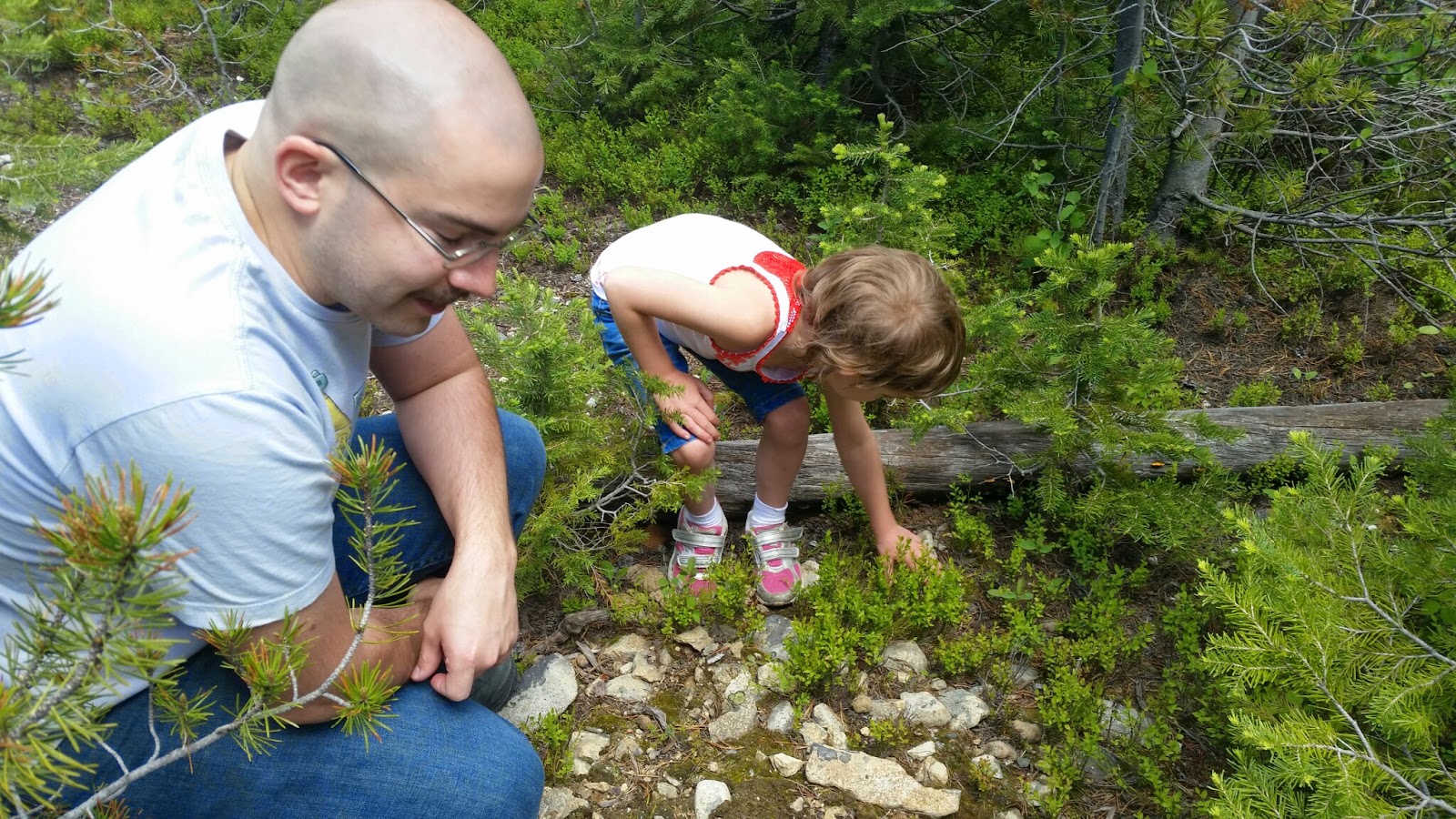
| On a Hike |
![]() |
| On the Road |
![]() |
| When Mom Got a Shot |
![]() |
| At the Zoo |
![]() |
| At Pride Fest |
![]() |
| On the Computer |
![]() |
| On the XBox |
![]() |
| In the Garden |
![]() |
| On a Trail |
![]() |
| On the Couch |
![]() |
| While Playing Games |
![]() |
| While We Were Sick |
![]() |
| At the Table |
![]() |
| On a Walk |
![]() |
| While Taking Stuff Apart |
This post is part of the "NOT back-to-homeschool" blog hop through iHomeschool Network
Subscribe to:
Comments (Atom)